
Did you know you can save money by diluting whole milk? Yes, yes you can! Do you already do this?
If you normally drink 2% or 1% milk, and haven’t tried diluting your milk before, you might want to give it a go.
Last month when I was pinching pennies with my one hundred dollars a month grocery budget challenge, {starting with ZERO items in the pantry} longtime reader Cindy left this comment:
“Why not save yourself even more — and stop buying 2% milk? Buy whole, instead, and dilute it with water – at least 1/3. {Even up to a half.} You will not notice the difference — I swear it. In fact, I think it tastes much better than commercial 2%.”

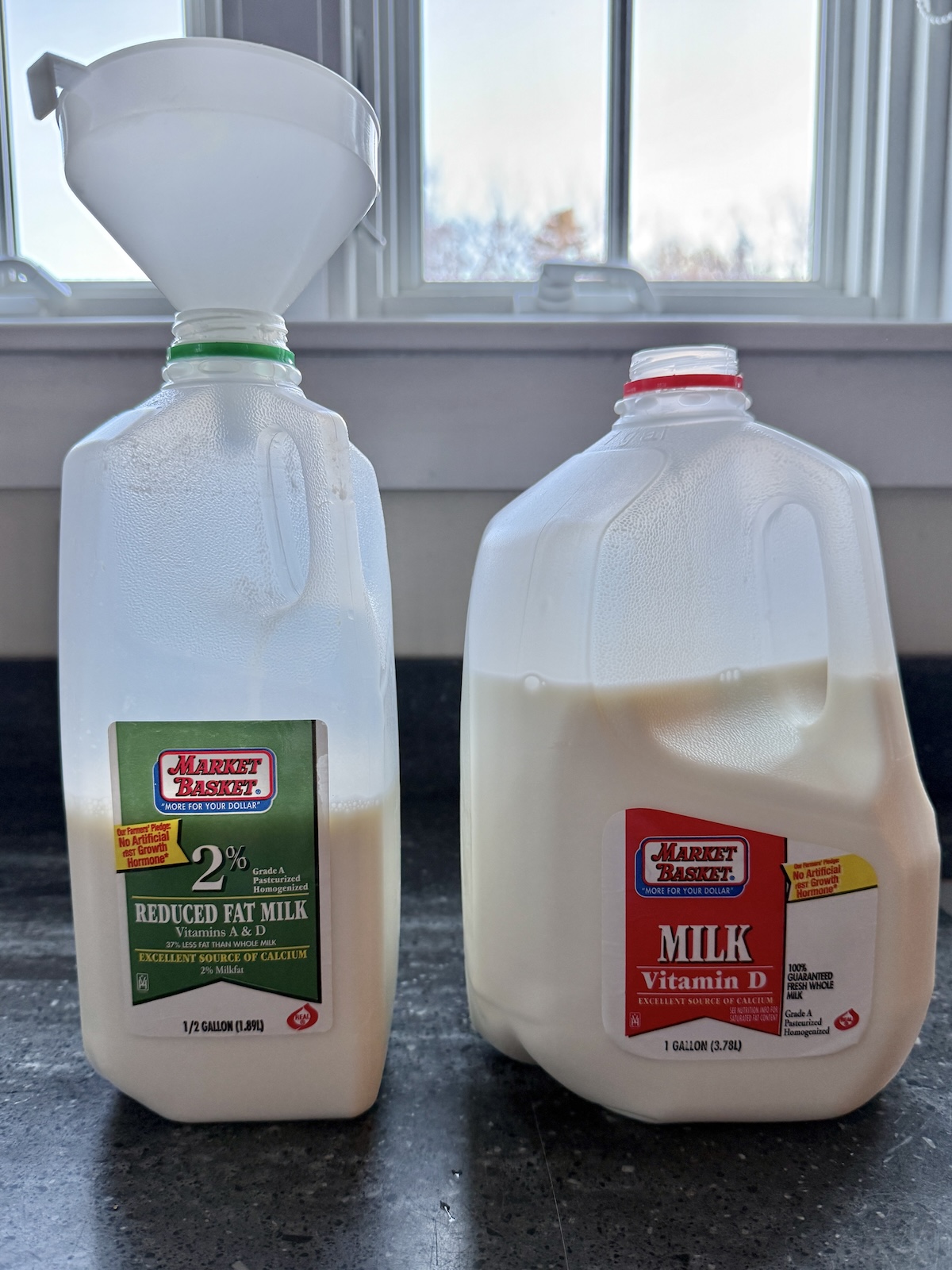
Well long story short, I tried diluting my milk and it worked!!
I normally buy 1 ½% or 2% milk so I was eager to give Cindy’s suggestion a try. I thought for sure the milk would taste weird.
I tried both her suggestions; diluting the milk with ⅓ water and also diluting the milk with half water.

The milk that was 50/50 {equal parts milk and added water} tasted exactly like nonfat milk.
The milk that was 70/30 {70% milk, 30% added water} tasted just like the 2% milk I normally buy.
Holy cow man! Thanks to Cindy’s suggestion I’ll be buying whole milk from now on. Seriously, you need to try this!

If your family normally drinks 2%, 1% or nonfat milk it’s a great way to save a buck or two every time you buy milk.
I don’t know about you, but I am constantly in awe of the fact that there are still so many ways to whittle down a grocery budget I haven’t heard of/tired yet.
Well done Cindy!! Great suggestion. Keep them coming!
Carry On.
~Mavis

Yma P says
Does diluting the milk with water reduce the amount of calcium that you get?
Jennifer says
Yes. They are only removing fat to make skim, 1%, 2%, etc. but the full nutrition of the milk remains. Adding water to fattier milk is lowering the nutrition. Just think – you get all the nutrition available in half a carton of milk, compared to the nutrition of a full carton of milk. So a great idea if you are looking to stretch a grocery budget, but if you are feeding children or elderly, I would not recommend it. Hope this helps!
Rosemary says
That’s a great idea – especially if you have kids that go thru gallons of milk. I used to buy a gallon of the 2% milk and then pour it into 8 pint jars and freeze them. I typically only use a pint a week. Then I tried the instant 2% milk powder. After mixing it up, let it get cold and it tastes similar to the 2% in the jug. If you use it right after mixing it, it won’t taste as good. Being chilled is what works, at least for me. I can stock up with bags of the powder, and I don’t use up any space in my freezer (I only make one pint at a time unless I will be using it in recipes). I have used it in my tea, cereal, pudding, creamy sauces, etc. and it has worked well.
Margo says
Replacing milk with water may not alter the taste but is not something you should do if you are using milk for children or at risk adults. Water has no nutrition and adding to milk decreases the overall nutrition in it. Another healthier choice would be to substitute reconstituted powdered milk for half of the store bought milk. Not as cheap as water, but still savings are to be had. I did this during my penny pinching days years ago and it helped the budget.
Elizabeth M says
That’s a good idea. I don’t drink milk anymore, but I use coconut milk sometimes, and I often dilute it to make it last longer. I do the same with fruit juices. They still taste good at half strength. As mentioned, I wouldn’t do this for children or anyone who relies on liquids for a lot of their nutrition, but it works for me.
debbie in alaska says
I remember reading about the chemical process they use to make reduced fat milk and it wasn’t pretty. So I think this is a better option if you are trying to avoid what my doctor once called a “chemical sh*t storm” that is reduced fat products.
KC says
… normally reducing the fat in milk does not require a chemical process? You just let the cream rise to the top, remove it, then add back however much to get 1% milkfat, 2% milkfat, 4% (whole), etc. It’s an… old… process. Homogenization, so the cream stays put instead of you needing to shake the carton every time you want some whole milk, is more recent. Heating milk to kill germs is also fairly old (although people knew germs were involved, it used to be “heating to make the milk more digestible to invalids and children”); the exact process of pasteurization (heating the milk in a very specific way so that you retain more of the nutrition of the milk *but* the germs are killed) is newer.
(unpasteurized milk killed *so* many kids in the late 1800s and early 1900s; tuberculosis and “summer complaint” aka a whole bunch of GI illnesses common in the summer, which grew rapidly in milk in warmer temperatures and killed an enormous number of babies each year)
There are lots of reduced-fat things that are super-questionable in terms of how they’re made or what’s added to them to make it less obvious it is reduced-fat, but with milk you just need time and gravity to do the work?
debbie in alaska says
Maybe that’s how small batch producers do it — but my understanding is that large scale milk producers use chemicals. I could be wrong. Folks can look it up if they are concerned. But I avoid low fat whenever possible.
debbie in alaska says
KC, looks like you’re right when it comes to milk. Looks like it’s the majority of other low fat items that relies on chemicals. I can’t modify a previous comment so I’m adding a mea culpa here.
KC says
No problem! There is a *lot* of low-fat stuff that is… uh. Not great. Just, milk is one of the few where low-fat milk is not unnatural anad is actually great for people who need less fat but still need the calcium+protein. 🙂
Whole milk is fine to use if the fat+cholesterol aspects aren’t a health issue at play; 2% works well for a lot of people as a compromise between enjoyment and their health issues; I don’t personally like skim *at all* but it does still deliver on the other nutrients and some people are okay with it and it’s not problematically chemical in any way, so, sure.
(but yes. if a product is “reduced fat” or “reduced sugar” then check the label to make sure that it’s not being problematic in a different direction, in general!)(some things are “reduced sugar” simply because they have less added sugar and taste less sweet and I love it when companies give us that option, but the rest of them: whew yikes)
Lee says
Skim or fat free milk is processed using only a centrifuge, no chemicals.
Cindy Brick says
Awwww…. thank you for the kind words, Mavis! You are welcome, friend.
I had read tips to add dry milk to the regular… but I could taste the difference, and so could my family. I will use dry milk or shelf-stable in an emergency, or for cooking, if I’m running low. (We now live 25-45 min. from a grocery store, so you don’t just trot off whenever you feel like it.)
We get calcium in other foods we eat, so I am not concerned about the loss of nutrients here. I do know that this has saved me several times from trudging off to the store…and I feel better for not getting as much fat in our overall diet. Hey, $$ saved, in for something as basic as milk, really helps stretch our food budget.
Anne P. says
I actually started this a while ago because my husband liked whole milk and I liked the 2%. Our kids were grown and we didn’t need to buy two different kinds of milk for 2 of us. I just figured I could add water to dilute. I don’t dilute it like you do. I just dilute it as I use it. I figured adding water from the tap with chlorine might not be good to add into milk all at once. Not sure about any of that but diluting it as you go keeps the milk pure longer. Just a suggestion.